
If you’ve ever nodded along in a business call while someone said “we need better processes” or “let’s build a workflow for this” or “our systems are a mess” and quietly wondered if those all meant the same thing you’re not alone.
These four words get used interchangeably all the time, but they’re not the same thing, and mixing them up is one of the quiet reasons operations work stays confusing. Once you see how they actually relate to each other, building out your business operations gets a lot less overwhelming. Here’s the breakdown.
In simple terms:
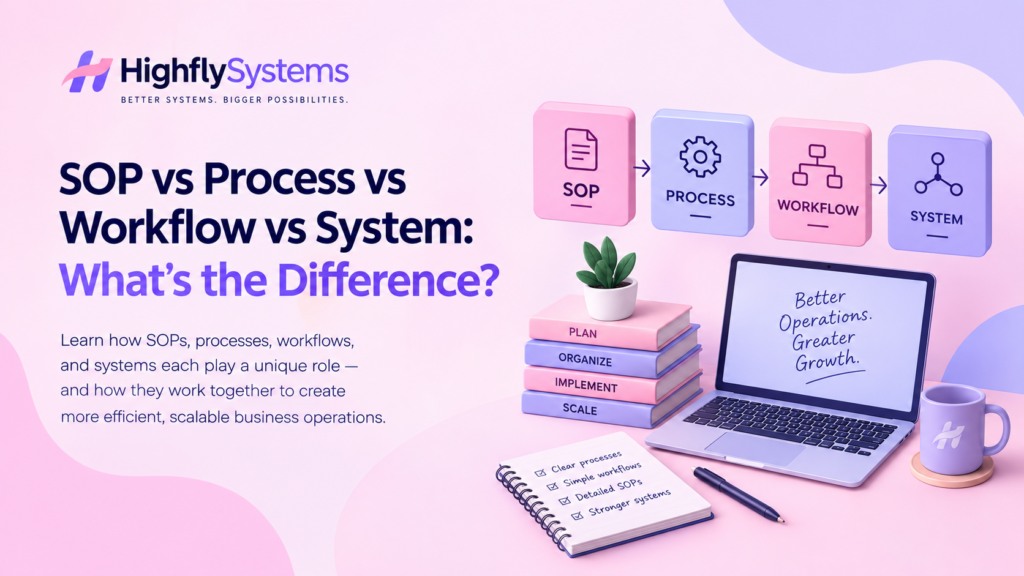
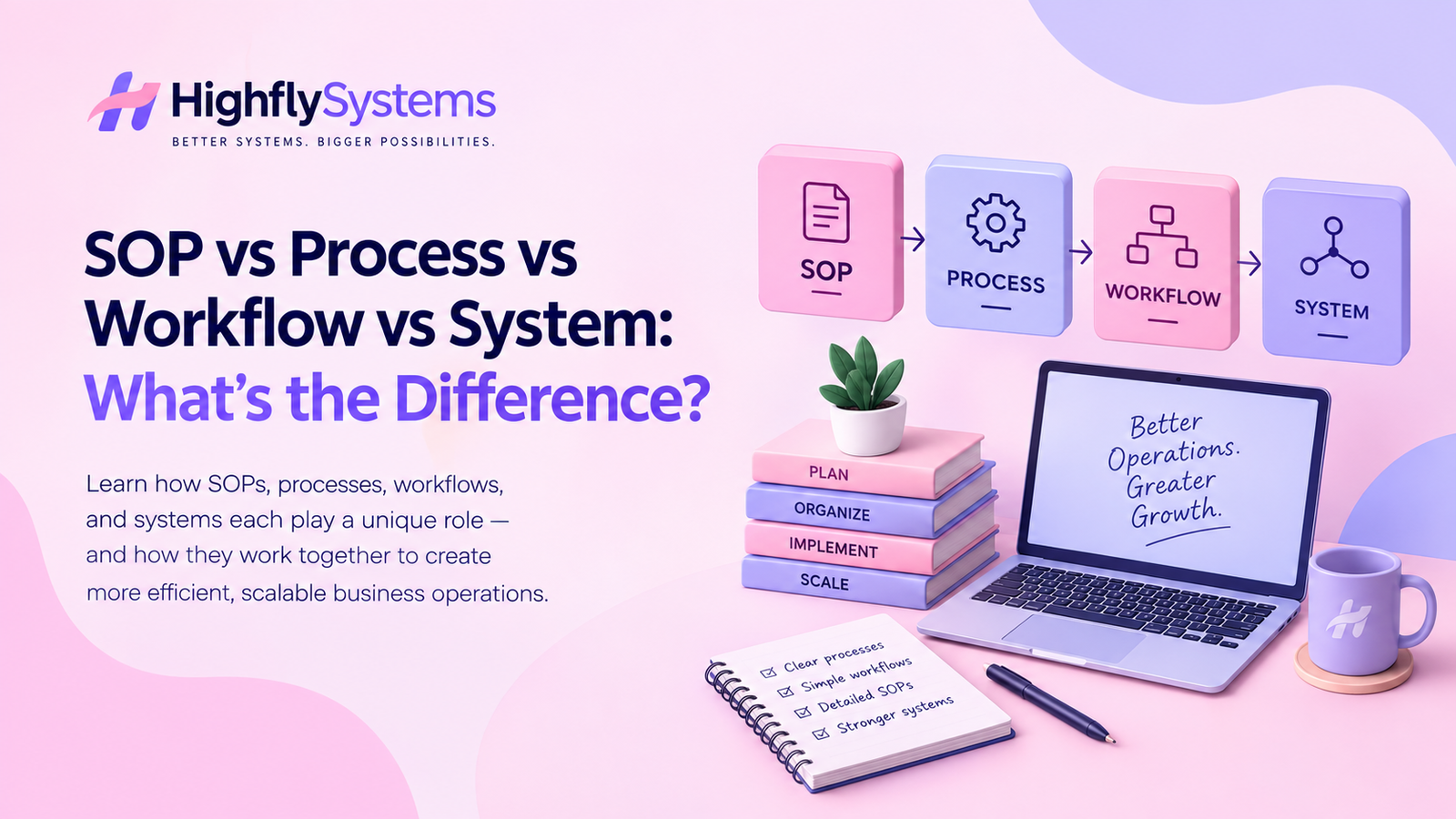
SOP: How to perform a specific task.
Process: The series of activities required to achieve an outcome.
Workflow: How those activities move from one step to another.
System: How all the people, processes, workflows, tools, and procedures work together.
System: The big picture
A system is the overall structure that makes a part of your business function, the entire way something operates, made up of everything underneath it. The processes, the tools, the people, and the rules that connect them.
Think of your “client onboarding system” or your “content system.” It’s not one document or one action, it’s the whole machine, and everything below fits inside it.
Example: Your “sales system” includes lead capture, follow-up sequences, proposal creation, contract signing, handoff to delivery and all of it, working together.
Process: The stages inside the system
A process is a series of related steps that move something from a starting point to an end point. It’s a level down from “system”, a process is one piece of the machine, not the whole machine.
Processes answer: what has to happen, in what order, and how do we get from A to B?
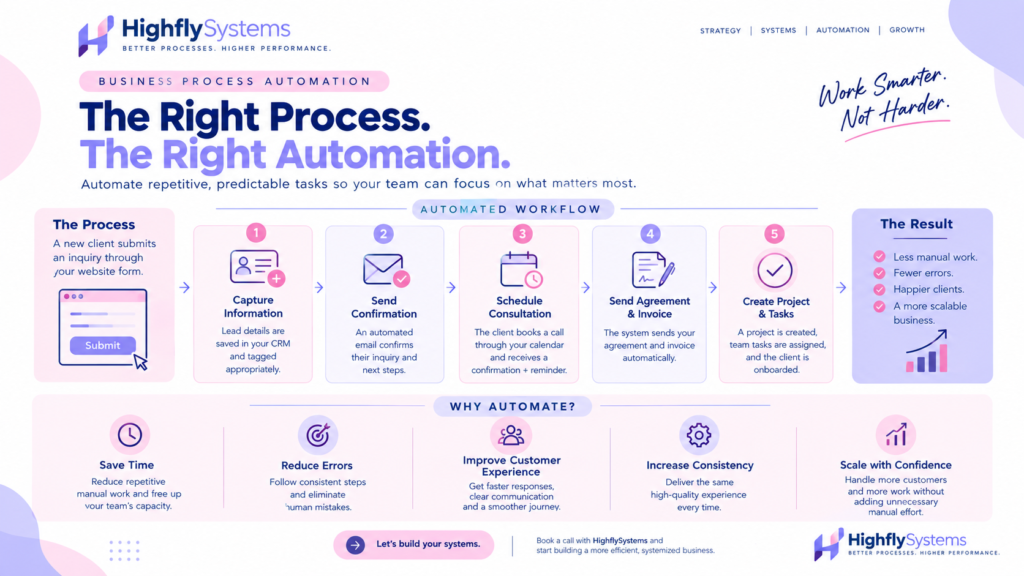
Example: Within your sales system, “lead qualification” is a process: a lead comes in → gets tagged by source → gets a discovery call booked → gets marked qualified or not.
Workflow: How the process actually moves, especially between people or tools
A workflow describes the movement of a process, specifically how tasks pass from one person, tool, or stage to the next. It’s about handoffs and sequencing, often visualized as a flowchart.
Where a process tells you the stages, a workflow shows you the traffic: who does what, when, and what happens next based on different outcomes.
Example: In your lead qualification process, the workflow might be: form submission → auto-tag in CRM → notification to sales rep →sales rep books call → call outcome triggers either a proposal workflow or a “not a fit” email sequence.
SOP: The exact instructions for one task
A Standard Operating Procedure (SOP) is the most zoomed-in of the four. It’s a specific, detailed, step-by-step set of instructions for completing one particular task, written so clearly that someone with no prior context could follow it and get a consistent result.
An SOP isn’t the whole process; it’s the instruction manual for one piece of it.
Example: “How to tag a new lead in the CRM” is an SOP: log in, click X, select the correct tag from this list, save, notify the assigned rep in Slack using this template.
How they all fit together
Here’s the simplest way to see the relationship, from broadest to most specific:
System → made up of several Processes, Process → made up of a Workflow (the sequence/handoffs) and one or more SOPs (the exact direction for each step)
So your sales system contains your lead qualification process, which follows a specific workflow of handoffs between your CRM and your team, and each step in that workflow is executed using a documented SOP.
Why Businesses Need All Four
Many business owners document an SOP and assume they have created a system.
But that is just one piece of the puzzle. You can have 50 excellent SOPs and still have a disorganized business if your processes aren’t clearly defined and your workflows aren’t connected.
For example, you might have an SOP for:
- Sending invoices
- Responding to leads
- Creating social media posts
- Onboarding employees
- Processing orders
But if nobody knows when to use each SOP, who owns the task, what happens before it, or what happens afterward, your business can still experience confusion.
That’s why effective business operations require a bigger picture.
Knowing the difference helps you:
- Diagnose the real problem. “Our system is a mess” usually means several processes need attention, not just one document.
- Build in the right order. Map the system and its processes first, then design workflows, then write SOPs for each step building bottom-up without a system in mind that creates disconnected pieces.
- Delegate more clearly. Handing someone an SOP is very different from handing them ownership of a whole system knowing which one you’re actually delegating prevents confusion and gaps.
Untangling systems, processes, workflows, and SOPs so your business runs smoothly without you having to hold it all together is exactly what we do at HighflySystems.