If you’re the only person who knows how everything gets done in your business, you don’t run a business, you own a very demanding job.
That’s the blunt truth behind burnout stories from most small business owners. You started your business for freedom, but somewhere along the way you became the glue holding every process together. Every task lives in your head. Every decision needs your input. Every new hire has to be trained by you, because you are the system.
Systemizing your business is how you get out of that trap. It’s the process of turning the things you do from memory and instinct into repeatable, documented, and (eventually) delegate-able processes. So your business can run without you being the bottleneck for every single thing.
Here’s a step-by-step guide to actually doing it.
Step 1: Audit What You’re Actually Doing
Start by mapping out everything that happens in your business over a week or month. To every recurring task, no matter how small.
- Onboarding a new client
- Posting to social media
- Invoicing
- Responding to customer inquiries
- Fulfilling orders
- Following up on leads
A simple way to do this, is to keep a running list for 1–2 weeks of every task you do. However, minor patterns will emerge fast and you’ll likely find out 80% of your time goes into a much smaller set of repeating activities than you least expected.
Step 2: Prioritize by Frequency and Pain
Don’t spend three months documenting 100 processes that nobody uses, start with one high-impact process, Improve it then move to the next.That’s where systemizing gives you the fastest return on your time.
Step 3: Document the Process As It Exists Today
Before you improve on anything, write down how the task is currently done step by step,do not skip this by jumping straight to “the ideal way.” You need an honest baseline first.
For each process, capture:
- The trigger (what starts this task?)
- The steps, in order
- Who’s involved
- What tools or platforms are used
- What “done” looks like
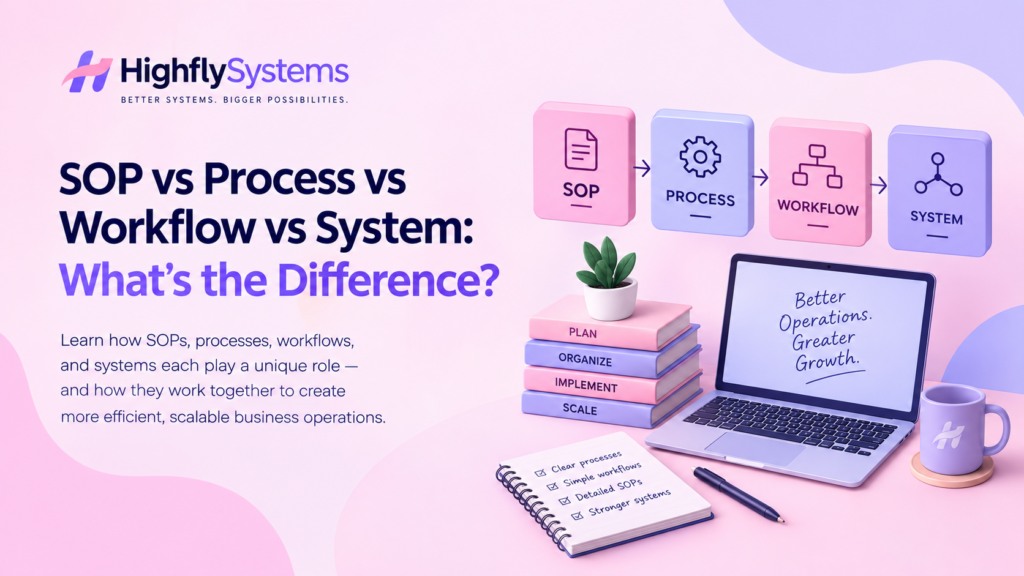
This can be a simple checklist, a flowchart, or a written SOP (Standard Operating Procedure). The format matters less than the fact that it now exists outside your head.
Step 4: Simplify Before You Systemize
Once it’s on paper, look at it critically. Are there unnecessary steps? Redundant approvals? Manual work that could be automated? Systemizing a broken process makes the business run a process more efficiently so tighten it up first.
Ask of every step: Does this need to happen, and why should it ?
Step 5: Build the System
Now turn your simplified process into an actual system, something someone else could follow without asking you questions. This usually includes:
- A written SOP, with screenshots or short video walkthroughs where helpful.
- Templates for anything repeated (emails, proposals, social captions, contracts).
- Checklists to make sure no step gets skipped.
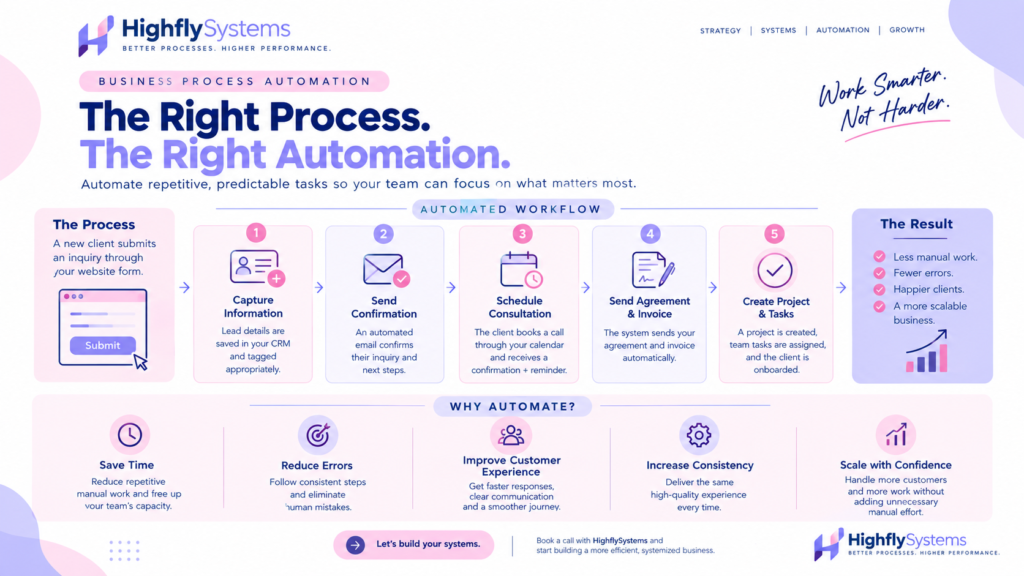
- Automations for the parts that don’t need a human at all, think scheduling tools, email sequences, invoicing software or Zapier-style integrations connecting your apps.
The goal is for a system so clear that a new hire could follow it immediately and get the result you desire.
Step 6: Centralize Everything in One Place
Scattered systems are almost as bad as no systems. If your SOPs live in ten different Google Docs, three notebooks, and your memory, no one can find or trust them.
Pick one home for your systems: A shared drive, a project management tool (like ClickUp, Notion, or Asana), or a dedicated operations manual. Organize by department or function (Sales, Client Delivery, Marketing, Admin) so anyone can find what they need without hunting.
Step 7: Assign Ownership
A system without an owner tends to rot. For each process, name who is responsible for running it and who is responsible for keeping the documentation updated when the process changes. This is also where systemizing sets you up to delegate. Once a process is documented, it becomes something you can hand off with confidence instead of anxiety.
Step 8: Test, Get Feedback, and Refine
Have someone other than you run the process using only the documentation, no verbal explanation, no “let me just show you.” Watch where they get stuck. Those sticking points are gaps in your system, not failures on their part.
Update the SOP based on what you learn. Systems shouldn’t be”set and forget”, but should evolve as your business does.
Step 9: Revisit Regularly
Set a recurring check-in (quarterly works well for most small businesses) to review your systems. Are they still accurate? Has a tool changed? Has the team grown in a way that needs a new step or a different owner? Treat your systems documentation as a living resource, not a one-time project.
The Payoff
Systemizing isn’t about turning your business into a rigid machine, it’s about buying back your time and your sanity. Once your key processes are documented, simplified, and owned by the right people, you’re no longer the single point of failure. You can take a vacation without the business falling apart. You can bring on a new team member without spending a week training them from scratch. You can finally step into working on the business instead of being stuck working in it, every single day.
Start small, pick one recurring headache this week, document it, simplify it, and hand it off. That one system is the first trigger and it’s usually the one that convinces you the rest of the work is worth doing.
Book a Systems Strategy Call